
We’ve crossed the line.
Half a year gone,
already too much.
Hold on,
it’s not done with us yet.
Playability.
I’ve been noodling on a chapter in SLOP MACHINES called ‘In Game’, trying to build on why Worlds are the first emergent medium of the 21st century, and why all techno social systems should be seen as worlds.
One of things happening in culture that I think we can all feel intuitively, is that increasingly, media mediums are playable. I don’t mean ‘gamification’, and I don’t simply mean ‘engagement’ (but metrics inside of systems are certainly part of it). But the sense that people – Gen Z and Gen A, are literate in exploring systems. They poke at the rules, bend them, maybe even break them and see how the system responds far more than millennials did. We played the game, but didn’t fully appreciate that culture is an emergent property of a system’s design.
What counts as playable?
• Rule legibility: you can guess cause and effect by interacting with the system.
• Exploit headroom: there’s space to find workarounds the creators didn’t intend.
• Reward feedback: if something works, you get immediate feedback.
Once you learn to spot playability, you see it anywhere that requires ‘Playing the meta‘. Fortnite kids comb patch notes; TikTok creators speedrun trend cycles; memecoin traders hop chains and farm the real time attention economy, economic entertainment is emerging, Stock markets have become a platform for oldskool 4chan raids. With playable media, the content barely matters, playing the system is the content.
To do that, you need fluency in the Code Space you are interacting with. Living inside platform updates rewires your nervous system, all social media creators know how this feels. Fortnite’s shrinking circle retrains time-pressure reflexes. Minecraft encourages modularity and long-term planning. Meme-coins condition you to embrace volatility, and to surf chaos.
Over time, these rhythms become second nature. Stability, by contrast, begins to feel alien. The world outside of EXOCAPITALISM, feels too slow, too inert, and too dull.
Politics is now playable too. You tweet out your opinion, or make a comment on facebook, a youtube video and navigate the public sentiment. You can outrage farm or become a reply guy, there’s plenty of player styles. Conspiracy threads are like alternate reality games. Politicians use viral momentum as a scoreboard too; most long term policy is an afterthought. Keeping the game going is the goal, not resolution or ending it. Trump is very good at this.
Generative media is playable too, more so than ever before. But as i said, the content really doesn’t matter, our current social media platforms as playable systems don’t really reward quality anyway; they reward throughput. Machines are always going to win that game.
I should be clear, ‘playability’ isn’t ‘gamification’. As someone who spent a decade in HR tech, gamification (In my opinion) is mostly about obedience theatre. Badges on the coffee app, loyalty points, and mechanics to get you to finish your training. Gamification is used to make you feel like you’re playing when you’re really just complying. Playability is something else entirely. It’s embedded in the physics of a system, and as a mode of interaction. It invites experimentation, rewards cleverness, and tolerates failure. IMO DeFi yield farming is playable. A stamp card is not.
So how do people learn to navigate these spaces? They play. They watch walkthroughs, argue on Discord, test hypotheses with real money. Failure isn’t final, it’s part of the loop. For many of the crazy Gen Z and Gen Alpha crypto kids I’ve interacted with, a blown-up financial position is just a re-start. This time with a funnier twitter handle and maybe a slightly more optimal strat. These kids are learning the contours of the new Web3 financial system through practice, iteration, and community.
Code writes the rules. Rules shape incentives. Incentives shape behaviour. And behaviour becomes culture.
The point I’m trying to make isn’t that “everything’s a game.” Instead I want to see / stress that all techno-social systems can/are become are playable media.
Back to the point on behaviour becoming the culture. Right now in the US, gambling and sports betting is emerging as one of the most playable mediums and forms of media.
I saw this meme the other day:
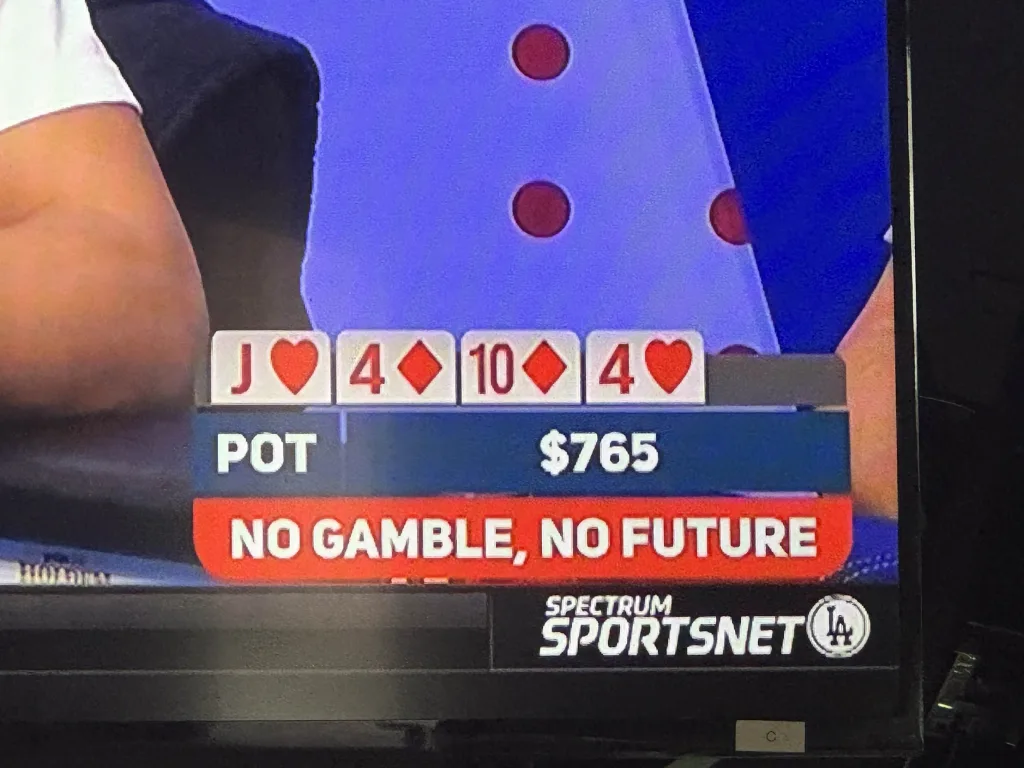
As a Solarpunk who thinks about the future, I think this is a little grim. But it does speak to something important.
It reflects the economic reality of Exocaptialism. The most obvious cultural metaphors we have to describe playable media and systems are either the Casino and video games. Unfortunately both already fused a longtime ago. You really do need to realise that NFT flippers and memcoin traders, don’t care about money as much as you think they do, they just want to play games.
As more systems become legible and playable, it’s the logic of the casino, not capitalism! that seeps out into the rest of life. This is why playability matters. Not because everything is a game, but because we are all beginning to think like players, and this changes how we should understand agency inside of systems.
It’s hard to resist the casino, capitalism is even harder, but recognising that a system is playable is the first step toward navigating it with intent rather than just reacting to it. But it also makes us realise that the rules of the game can be changed at any time. By the players or the worldrunners.
Update: Added a slightly tweaked and updated version of this text into my essay collection on worlds at worldrunning.guide
On The Blog:
BBC: Future of the Social Internet Report
A while ago I was interviewed and invited to contribute to BBC R&D’s Future of the Social Internet Report, which explores the shifting dynamics of digital social platforms and online communities.
That report has just dropped: Projections: The Social Internet.
Permanently Moved
No-Go London
If life already feels precarious on your own high street, then a city like London must be ten times worse?
Full Show Notes: https://zexulo.xyz/2025/06/21/2515-no-go-london/
Experience.Computer: https://experience.computer/
Worldrunning.guide: https://worldrunning.guide/
Subscriber Zine support the show! https://startselectreset.com/Permanently moved is a personal podcast 301 seconds in length, written and recorded by @thejaymo
Subscribe to the Podcast: https://permanentlymoved.online/
Quarterly zine; my gift to you ✉️




Photo 365
The Ministry Of My Own Labour
- Pulled nearly 3 years of notes into one document and topped the full number up to 100.
- Lots of research this week on products and features for a game engine I’m working on.
- Had a call with Microsoft Textworld’s team.
- Had a long call about vibe coding and the steps to go from figma to xcode
- Wrote a really long entry on a mailing list on Apples AI strategy might turn it into a blog post.
Terminal Access
Political Dimensions of Solarpunk…Ten Years Later – Andrew Dana Hudson
We’ve spent a decade imagining better futures. Now what?
Earlier this week Andrew Dana Hudson dropped a long read reflecting on the 10 year anniversary of his hugely influential 2015 essay ‘The Political Dimensions of Solarpunk‘
Some excerpts below:
Probably the most important solarpunk development of the decade, though, is that we were right to bet on solar power. The technology could have plateaued. Instead, costs keep dropping. Efficiency keeps improving. Deployment keeps hockey-sticking. Circularity is getting closer. Land use is looking less zero-sum. A lot of this is thanks to China, but everyone is getting a piece of the action. Solar panels are now cheaper per square meter than wooden fencing.
And certainly, many would love to just build the garden-roofed ecotopia without all the messy class struggle, the delicate balancing of various environmental and community concerns (red tape, ugh!), the slow growing of real grassroots resilience and power? Solarpunk subreddits, Facebook groups, and other image-forward spaces have long fielded debates about whether solarpunk *had* to be anti-capitalist. This is one of the hazards of being an aesthetic as well as an ideology.
There’s a lot more we can say about both of these challenges, but in short they make doing solarpunk both harder and more necessary. The more cyberpunk the world gets, the more useful solarpunks become. The more material reality is buried under layers of digital abstraction, the better it feels to actually get your hands dirty.
Despite the challenges——or perhaps because of them——solarpunk has, on balance, been a tremendously successful “memetic engine.”
Horus and Motherfucker – Eddie Rathke

In more ‘friends doing things’ terminal access news, Eddie Rathke has a Kickstarter for his new novel. Illustrations by the good TonyTran.
Here’s the pitch:
The Adventures of Horus & Motherfucker is an ultraviolent sword & sorcery black comedy about two escaped slaves wandering the countryside killing monsters and chasing god.
But after reading The Adventures of Horus & Motherfucker in a single sitting at my house while I did my day job, he told me it was essentially unpublishable. Too dark. Too weird. Too many jokes. Too much cannibalism.
Dipping the Stacks
My AI Skeptic Friends Are All Nuts · The Fly Blog
I think this is going to get clearer over the next year. The cool kid haughtiness about “stochastic parrots” and “vibe coding” can’t survive much more contact with reality. I’m snarking about these people, but I meant what I said: they’re smarter than me. And when they get over this affectation, they’re going to make coding agents profoundly more effective than they are today.
Tom, who works in IT for the government, doesn’t use AI in his tech work, but found colleagues were using it in other ways. Promotion is partly decided on annual appraisals they have to write, and he had asked a manager whose appraisal had impressed him how he’d done it, thinking he’d spent days on it. “He said, ‘I just spent 10 minutes – I used ChatGPT,’” Tom recalls. “He suggested I should do the same, which I don’t agree with. I made that point, and he said, ‘Well, you’re probably not going to get anywhere unless you do.’”
21st Century Dark Age: will the elision of advertising and entertainment kill art?
We consume art, just as we consume content (whether that’s consuming journalism or consuming pornography). Delineation of materialism by virtue of tangible or intangible – pretending there’s some moral boundary there – feels foolish. There is no real ethical difference between spending £10 to buy synthetic eyelashes, and spending £10 to stream Citizen Kane.
But what we’ve relied on previously is a balance, where the commoditisation of art is offset by the commoditisation of everything else. As my partner observed of the Gen Z woman scrolling through reel after reel of product placement on the plane, we (millennials) used to tolerate advertising during a TV show because sitting through it meant that we could get to the good stuff.
Physicality: the new age of UI
I love products with innovative, novel interfaces — modern iOS isn’t a simply a product, but a platform. Its designers bear responsibility to make the system look good even in uncontrolled situations where third party developers like myself come up with new, unforeseen ideas. That leaves us with the question of how we can embrace a new, more complex design paradigm for interfaces.
Luria observed that whenever he asked an oral interviewee to engage in self-analysis, they would experience difficulty. He observed that self-analysis like we rely on in literate cultures requires “a certain demolition of situational thinking. It calls for the isolation of the self, around which the entire world swirls for each individual person, removal of the center of every situation from that situation enough to allow the center, the self, to be examined and described.”
Reading
I still have the last two books of the year to read but they are both dense and hard going. So despite my resolution I’m taking a break. Finally reading Right Story, Wrong Story by Tyson Yunkaporta. And I used Audible credit to get Interceptor City, Dan Abnett’s follow up to his 40k pilot/flight ace book ‘Double Eagle‘. As usual Toby Longworth’s performance as narrator is fantastic.
Music
HAIM – Relationships
Pop queens HAIM have a new album out very soon. I’m looking forward to it. This first single is catchy as hell. Look, I know they are multiplatinum, and Grammy nominated but there are so many people in this world, some my friends who are musos, who don’t know that the HAIM sisters have been cranking out top tier pop since 2007 at all. It’s baffling.
Remember Kids:
“…fear and courage are like lightning and thunder; they both sart out at the same time, but the fear travels faster and arrives sooner. If we just wait a moment, the requisite courage will be along shortly.”
The Courage to Write by Ralph Keyes
Newsletter 📨
Subscribe to the mailing list and get my weeknotes and latest podcast episodes, sent directly to your inbox


Leave a Reply